
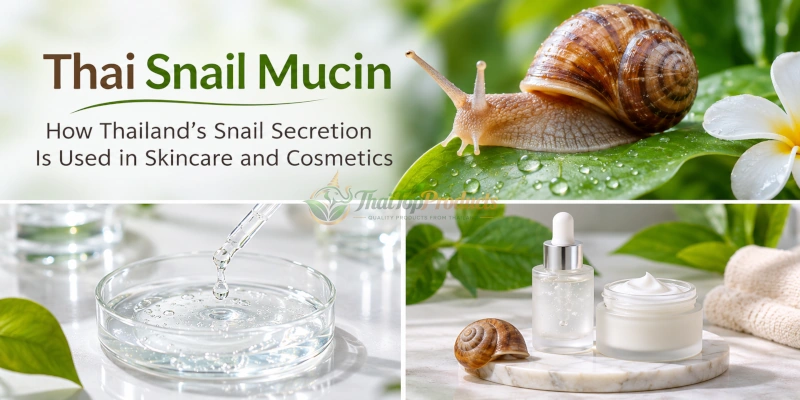
Thai snail mucin has become a familiar ingredient in modern skincare, but the story behind it is more interesting than a beauty trend. In Thailand, researchers and local businesses have explored the secretions of native land snails as a source of cosmetic ingredients. One species discussed in Thai research is Hemiplecta distincta, a land snail found in Thailand.
This guide looks at what snail secretion filtrate is, how Thai research has approached it, how the ingredient is prepared for cosmetic use, and what current evidence can—and cannot—tell us about its role in skincare.
What Is Snail Mucin?
Snail mucin is a common name for the mucus or secretion produced by snails. In cosmetic ingredient lists, a processed form is often identified as Snail Secretion Filtrate. It is not a single purified molecule. It is a complex mixture whose composition can vary with the snail species, the part of the body producing the secretion, the animal’s environment, and the collection and processing methods.
Snails produce different types of mucus for different biological purposes. Their secretions help with movement, attachment and protection. Cosmetic manufacturers may use appropriately collected and processed secretion as an ingredient in formulas such as essences, serums and moisturising creams. The finished cosmetic is a formulated product: its overall performance depends on the full ingredient list, concentration, formulation and quality controls, not on snail secretion alone.

Thai Snail Species and Local Research
Thailand has a rich diversity of land snails, and local researchers have investigated whether native species could provide useful bio-based materials. One species that appears in this work is Hemiplecta distincta, a land snail recorded in Thailand and studied alongside the giant African land snail, Lissachatina fulica.
A 2021 study by researchers affiliated with Chulalongkorn University compared mucus collected from the mantle and foot of these two species. The researchers found differences in protein profiles between species and between the two body regions. In laboratory tests, the samples also showed varying levels of antioxidant, antibacterial and anti-tyrosinase activity. These are laboratory findings; they do not establish that a finished skincare product will produce the same effects on human skin.
The research is useful because it shows why the source species and the part of the snail from which mucus is collected matter. It also helps explain why “snail mucin” should not be treated as one identical ingredient across every product or supplier.
How Snail Secretion Is Collected and Processed
Collection methods differ between producers and research settings. Published research describes carefully handling snails, collecting secretion from selected body regions, and filtering the collected material before analysis. Commercial production requires additional controls so that a raw biological material can be assessed and prepared for cosmetic formulation.
For consumers and brands, useful questions include whether the supplier identifies the snail species, explains its collection method, follows appropriate hygiene and quality procedures, and provides specifications for the resulting filtrate. Non-lethal or low-stress collection approaches are an important area of discussion in current research, although practices can vary. A supplier’s sustainability or animal-welfare statements should be checked rather than assumed.
Filtration is part of processing, but it should not be confused with a guarantee that every possible contaminant has been removed. Manufacturers remain responsible for appropriate microbiological testing, ingredient specifications, preservation and finished-product safety assessments.
What Does Snail Secretion Contain?
Snail secretions are chemically complex. Research has reported proteins, peptides, glycoproteins, polysaccharide-related compounds and other substances. The exact profile is not fixed: it can change with species, environment, collection site and analytical method.
For that reason, it is better not to assume that every snail secretion filtrate contains the same amount of a particular compound, or that it naturally provides the same functions as a separately added cosmetic ingredient. The ingredient declaration and information supplied by the manufacturer are more useful than broad claims based only on the word “mucin.”

Potential Uses in Skincare and Cosmetics
In skincare formulas, snail secretion filtrate is commonly positioned as a skin-conditioning ingredient. It appears in products designed to support a moisturised, smooth and comfortable skin feel. Depending on the formula, it may be used in:
- Essences and serums: lightweight leave-on products used after cleansing.
- Moisturising creams: products designed to help reduce the feeling of dryness and leave skin feeling soft.
- Gel creams: lighter textures that combine water-based hydration with emollient ingredients.
- Sheet masks and other treatments: short-contact or leave-on formats that may include the filtrate alongside humectants and other skin-conditioning ingredients.
These are examples of cosmetic applications, not promises of a particular result. A product’s effect depends on the complete formula and how an individual’s skin responds.
What Does the Scientific Evidence Say?
There is scientific interest in snail secretions, but the strength of evidence varies by question. Laboratory studies can identify biological activity under controlled conditions. They do not, by themselves, prove that applying a cosmetic containing the ingredient will treat acne, heal wounds, remove scars, reverse ageing or change pigmentation.
A 2024 review in the Journal of Cosmetic Dermatology examined proposed dermatological and cosmetic uses of snail extract. The authors noted that much of the available literature was based on preclinical work or small clinical studies, and that larger, well-designed clinical trials are needed to support many of the claims made about the ingredient.
A separate 2025 review discussed the composition of snail slime, non-lethal collection approaches and possible future applications. It also highlighted how production conditions and collection methods can affect the material. Taken together, these reviews suggest that snail secretion is an interesting cosmetic raw material, while also showing why careful wording and further research are important.
One randomized, placebo-controlled study from Thai dermatology researchers evaluated a serum containing snail secretion filtrate together with calendula and licorice-root extracts for mask-related acne. Because the product contained several ingredients, the results cannot be attributed to snail secretion filtrate alone. It is a useful example of clinical research, but not proof that snail mucin by itself treats acne.
Thai Snail Mucin and the Wider Beauty Market
Thai research into native snail species offers one example of how local biodiversity can inspire cosmetic ingredient development. A presentation in the 2018 Recent Advances in Genomics and Genetics Conference proceedings described semi-natural farming of H. distincta and a GMP snail mucus filtrate facility established by SIAM SNAIL Co. in a Bangkok suburb in 2015. The presentation also discussed the development of cosmeceutical products using snail mucus. This is a historical research-conference account, not an independent assessment of product efficacy.
It is important to distinguish this local research from the broader international snail-mucin market. Not every product sold by a Thai brand uses secretion from a Thai snail species, and a product made in Thailand is not automatically made with locally sourced mucin. Buyers who care about origin should look for clear species, sourcing and manufacturing information from the brand or ingredient supplier.
How to Choose a Snail Mucin Skincare Product
When comparing products, consider the following practical points:
- Read the ingredient list: look for the declared cosmetic ingredient name and review the other ingredients in the formula.
- Check product information: choose brands that provide clear manufacturer details, directions and batch or product information.
- Look for transparent sourcing: if Thai origin is important to you, check whether the brand identifies the species and source of its snail secretion.
- Consider your skin: patch-test a new leave-on product, especially if your skin is reactive or you have a known sensitivity to snail-derived ingredients.
- Keep expectations realistic: treat snail mucin as one component of a skincare routine, not as a medical treatment.
Stop using a product if it causes persistent irritation or an unwanted reaction. People with known allergies or a history of reactions to snail-derived materials should seek appropriate professional advice before use.
Explore Snail Mucin Skincare from Thailand
Thai skincare products use a range of ingredients and textures, including snail secretion filtrate. The products below are examples available in our store. Check each product page for its full ingredient list, directions and product-specific details.
- Namu Life Snail White The Ultimate Intense Snail Mucin Cream — a cream-gel moisturiser featuring snail secretion extracts.
- Namu Life Snail White Moisture Facial Cream — a daily facial moisturiser with snail secretion filtrate.
- Namu Life Snail White Gold Cream — a facial cream combining snail secretion filtrate with other skin-conditioning ingredients.
- Namu Life Snail White Rejuvenating Advanced Cream — a facial cream with a multi-ingredient skincare formula.
Frequently Asked Questions
Is Thai snail mucin different from other snail mucin?
It can be, because the composition of snail secretion varies by species, collection site and processing method. “Thai snail mucin” is not a single standardised formula. Look for details identifying the species and source rather than relying on country-of-sale alone.
Is snail secretion filtrate the same as snail extract?
The terms are sometimes used loosely in general writing, but cosmetic ingredient names and supplier specifications matter. Snail Secretion Filtrate is a recognised ingredient name used on cosmetic ingredient lists. Check the exact ingredient declaration on the product.
Can snail mucin treat acne or scars?
It should not be presented as a proven treatment for acne, scars or other medical conditions. Some research has examined snail-containing formulas, but findings from multi-ingredient products or laboratory studies do not establish that snail mucin alone treats these concerns.
Can sensitive skin use snail mucin?
Some people may tolerate products containing snail secretion filtrate, while others may experience irritation or sensitivity. Review the full formula and patch-test a new product. Avoid use if you know you are allergic to the ingredient.
Does every Thai snail skincare product use Thai snails?
No. A product’s brand or manufacturing location does not establish the biological origin of its ingredients. Contact the brand or supplier for species and sourcing details if this is important to you.
Sources and Further Reading
-
- Noothuan et al. (2021), Snail mucus from the mantle and foot of two land snails, BMC Research Notes.
- Singh, Brown and Gold (2024), Snail extract for skin: A review of uses, projections, and limitations, Journal of Cosmetic Dermatology.
- Rashad et al. (2025), From Nature to Nurture: The Science and Applications of Snail Slime in Health and Beauty, Journal of Cosmetic Dermatology.
- Puaratanaarunkon et al. (2022), Randomized placebo-controlled study of a multi-ingredient serum for mask-related acne, Journal of Cosmetic Dermatology.
- Mahidol University research conference: Fundamental biodiversity research and bio-resource utilization—a case study of the Siam Snail company.