
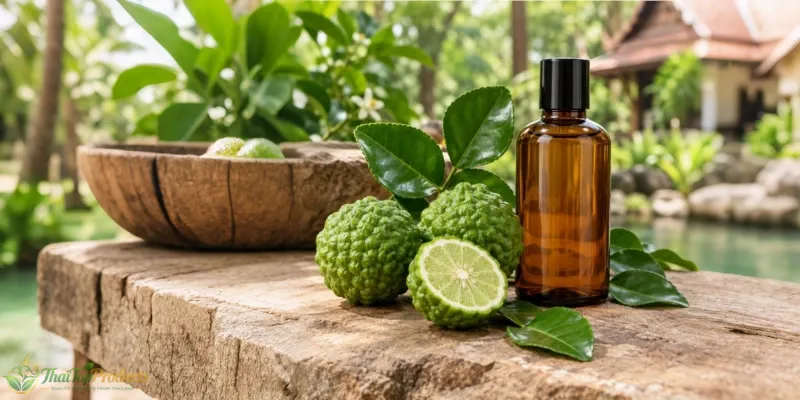
In Thailand, kaffir lime—also known as makrut lime (Citrus hystrix)—has long been part of everyday cooking and traditional personal-care routines. Its fragrant leaves and distinctive, textured fruit are also used to produce essential oils for cosmetics and hair-care products. But what does the research actually say, and how can you use kaffir-lime products thoughtfully?
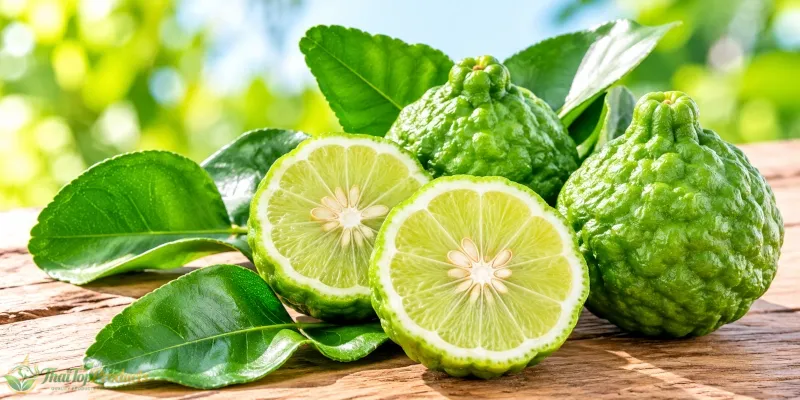
Why Kaffir Lime Is Used in Traditional Hair Care
Makrut lime has a fresh citrus aroma, and its leaves and peel contain volatile compounds that vary according to the plant part and how the oil is extracted. In traditional Thai hair-care practices, the fruit has been used in scalp and hair routines, including preparations intended to leave hair feeling clean. These traditions are useful cultural context, but they do not by themselves prove that kaffir lime treats a scalp condition or improves hair growth.
What Research Says About Kaffir Lime Oil
Laboratory studies have identified compounds such as citronellal, limonene, sabinene and related terpenes in kaffir-lime oils. A study by researchers affiliated with Rangsit University tested kaffir-lime peel essential oil against selected bacteria in laboratory conditions. Other research has examined its chemical composition and potential cosmetic applications.
These findings help explain why kaffir lime is of interest to personal-care formulators. However, results from laboratory tests are not the same as evidence from controlled studies on people. At present, there is not enough strong clinical evidence to say that kaffir lime alone prevents hair loss, makes hair grow faster, cures dandruff or reliably treats an itchy scalp.
Possible Benefits in a Hair-Care Routine
- A fresh, citrus scent: Kaffir-lime oil is aromatic and may be used to fragrance cosmetic products.
- A botanical ingredient: Extracts or oils may be included in shampoos and other personal-care formulas.
- A cleansing routine: A well-formulated shampoo can help remove oil, sweat and everyday buildup. The cleansing effect depends on the complete formula—not simply on the presence of kaffir lime.
Think of kaffir lime as a traditional botanical ingredient rather than a guaranteed solution for a specific hair or scalp concern.
How to Use Kaffir Lime Products More Safely
For everyday use, choose a commercially formulated shampoo and follow its label directions. Avoid applying undiluted essential oil or concentrated lime juice directly to the scalp: either may irritate sensitive skin, and citrus ingredients can be unsuitable for some people. Patch-test a new product according to its instructions and stop using it if you notice burning, redness or persistent itching. If scalp symptoms continue or hair loss is sudden or significant, seek advice from a qualified healthcare professional.
Choosing a Shampoo for Your Hair and Scalp
Different scalps have different needs, so look at the product’s overall formula and intended use rather than relying on one botanical ingredient. For an oily scalp, you can explore Bergamot Extra Delicate Shampoo The Original. For normal hair or a normal-to-dry scalp, see Bergamot Delicate Shampoo The Original. Read each product label and choose according to your own scalp comfort and washing routine.
The Takeaway
Thai kaffir lime has a meaningful place in traditional hair care and contains aromatic compounds that researchers continue to study. It may be an appealing ingredient in a thoughtfully formulated product, but current evidence does not establish it as a proven treatment for hair loss or scalp disease. A gentle routine, a suitable shampoo and realistic expectations are a better starting point than relying on any single natural ingredient.
Frequently Asked Questions
Does kaffir lime help hair grow faster?
There is not enough reliable clinical evidence to show that kaffir lime makes hair grow faster or prevents hair loss. Research on its oils is still largely laboratory-based.
Can I put fresh kaffir lime juice on my scalp?
It is better not to apply concentrated lime juice or undiluted essential oil directly to the scalp, as these may cause irritation. Choose a formulated product and follow its label.
Is kaffir lime suitable for every scalp?
No single ingredient suits everyone. If you have sensitive skin, test a new product as directed and stop using it if irritation occurs.
A Simple Checklist Before Trying a New Hair Product
- Check the label and intended hair or scalp type.
- Follow the product’s directions and avoid undiluted essential oils.
- Stop use if irritation develops.
Seek professional advice for persistent scalp symptoms or unexplained hair loss.
Sreepian et al., Antibacterial activity of essential oil extracted from Citrus hystrix (Kaffir Lime) peels: An in vitro study, Tropical Biomedicine.
Kaffir Lime Essential Oil Variation in the Last Fifty Years, a review of how plant parts and origins relate to essential-oil composition.
Techniques for essential oil extraction from kaffir lime and its application in health care products, a review of extraction and product applications.