The Thai toothbrush tree, known locally as khoi (Streblus asper), is part of Thailand’s documented herbal and oral-care tradition. Thailand’s official herbal references list the leaf under the English name “Tooth Brush Tree Leaf,” and researchers in Thailand have examined potential oral-health applications. The history is worth exploring, but traditional use and early laboratory findings should not be mistaken for proof of a cure.
Meet the Thai Toothbrush Tree
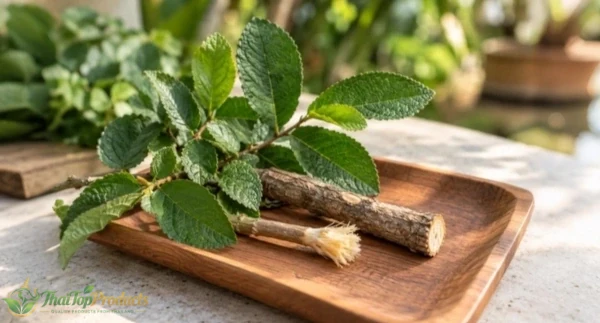
Streblus asper is a tree or shrub in the mulberry family, Moraceae. It is known in Thailand as khoi (ข่อย), and its leaves and other plant parts have a history of use in traditional medicine. The Thai Herbal Pharmacopoeia, published by the Department of Medical Sciences, identifies dried khoi leaves and notes their traditional category related to inflammation in gingivitis.
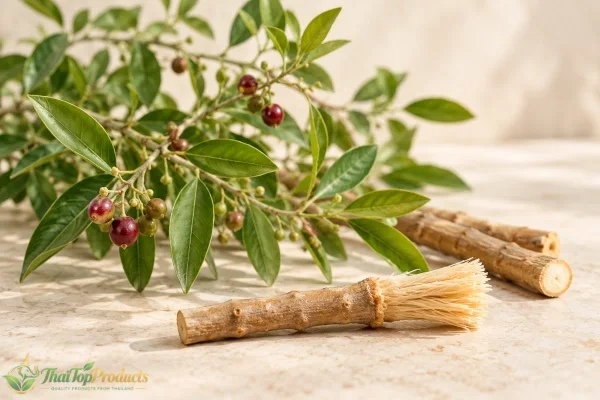
The English name “toothbrush tree” can be confusing because it is also commonly used for Salvadora persica, the plant associated with miswak chewing sticks in parts of the Middle East, Africa and South Asia. These are different species. When reading research or product labels, check the botanical name rather than assuming all “toothbrush tree” references concern the same plant.
What Does Thailand’s Herbal Record Tell Us?
Khoi is part of Thailand’s documented herbal tradition, and local dental researchers have studied its possible oral-care applications for decades. A review published in the Journal of the Dental Association of Thailand in 2015 described traditional uses of Streblus asper, including uses related to toothache and gum health, and discussed research into its biological activity.
These records support describing khoi as a traditional Thai oral-care plant. They do not, on their own, establish precisely how many centuries it has been used, nor do they prove that every modern product containing khoi prevents cavities or treats gum disease. Historical claims need historical sources; health claims need suitable clinical evidence.
What Has Scientific Research Found?
Thai researchers have investigated whether compounds from Streblus asper can affect bacteria associated with oral disease. A study published in 2000 examined the plant’s activity against mutans streptococci, bacteria associated with tooth decay. A 2022 report from researchers in Thailand also described antimicrobial activity from khoi leaf extract against selected oral-pathogen bacteria.
These findings are useful starting points, but laboratory tests do not tell us by themselves whether chewing a twig or using a toothpaste made with the plant will prevent cavities or improve gum health in daily life. Extract concentration, product formulation, how the ingredient is used, and the design and quality of clinical studies all matter. Researchers have also examined Salvadora persica miswak in clinical studies, but results for that different species should not be applied automatically to Thai khoi.
From a Traditional Plant to Modern Herbal Toothpaste
Modern herbal toothpastes combine plant ingredients with cleaning agents, flavouring, and sometimes active ingredients such as fluoride. Formulas vary from one brand to another, so a traditional ingredient does not tell the whole story. Look at the actual product label and directions, especially when choosing a toothpaste for cavity prevention.
On Thai Top Products, you can read about Dok Bua Ku (Twin Lotus) Herbal Toothpaste – Original, whose product information describes a traditional herbal formula, or Tepthai Concentrated Herbal Toothpaste Original, which lists fluoride in its product information. They are examples of current Thai herbal oral-care products; their formulations should not be assumed identical, and the products should not be treated as clinical proof for khoi itself. Check each package for the latest ingredients.
Can a Plant-Based Tooth Cleaner Replace a Toothbrush?
A suitable chewing stick can mechanically clean tooth surfaces when it is used correctly, but technique and access to all tooth surfaces matter. A conventional soft-bristled toothbrush is familiar and practical for most people, and it can be used with fluoride toothpaste as part of a consistent daily routine.
For cavity prevention, follow dental guidance to brush twice a day with fluoride toothpaste and clean between the teeth. Do not rely on a herbal ingredient alone to diagnose or treat tooth decay, persistent bad breath, or gum disease. If your gums bleed regularly or you have tooth pain, swelling, or ongoing symptoms, make an appointment with a dental professional.
How to Choose Herbal Toothpaste Carefully
- Check the botanical name: “Toothbrush tree” may refer to different plants in different regions; Streblus asper is the Thai khoi tree.
- Read the active ingredients: Look for fluoride if cavity prevention is a priority, and follow the product’s directions.
- Keep the basics in place: Brush gently twice daily and clean between teeth; herbal ingredients are not a substitute for a complete routine.
- Be cautious with big promises: Laboratory activity or traditional use does not prove a product can cure gum disease, stop tooth decay, or replace dental treatment.
Common Questions About the Thai Toothbrush Tree
Is khoi the same plant as miswak?
No. Thai khoi is Streblus asper, while miswak is most often associated with Salvadora persica. Both have been discussed in relation to oral care, but research findings for one species should not be transferred automatically to the other.
Does khoi toothpaste prevent cavities?
Traditional use and laboratory findings do not prove that a specific product prevents cavities. Check its active ingredients, including whether it contains fluoride, and follow routine dental-care guidance.
Has khoi protected Thai smiles for hundreds of years?
Khoi has a documented place in Thai herbal references and oral-health research, but a precise claim about hundreds of years needs specific historical evidence. It is more accurate to describe it as part of Thailand’s traditional herbal-care heritage.
The Takeaway
Thailand’s khoi tree (Streblus asper) has a meaningful place in documented herbal and dental research. Thai official references recognise the plant, and studies have investigated its potential activity against oral bacteria. Those findings are promising but do not justify saying that khoi alone has protected Thai smiles for hundreds of years or that it is a proven cure. The most reliable approach is to respect the tradition, read the evidence carefully, and maintain daily oral hygiene with appropriate dental products and professional care.
Further Reading
- Department of Medical Sciences, Thai Herbal Pharmacopoeia: Khoi leaf (Streblus asper)
- Journal of the Dental Association of Thailand (2015): Role of Streblus asper in Systemic and Oral Health
- Taweechaisupapong et al. (2000): Selective activity of Streblus asper on mutans streptococci
- Yuthchana et al. (2022): Antimicrobial activities of Streblus asper leaves extract in Thailand
- International comparison study: Salvadora persica miswak and the standard toothbrush (2021)—a different plant species